
10 Articles Every Christian Should Read About LGBTQ+ Inclusion
Confront Harmful Theology With God's Affirmation!

Article 1 🏳️🌈
False Claim: God Made Marriage for Men and Women
Misinterpreted Text:
“Therefore a man leaves his father and his mother and clings to his wife, and they become one flesh.” - Genesis 2:24
The Bible is often used to clobber LGBTQ+ people by folks who rarely engage scripture deeply. Over the next few weeks, I’ll be unpacking these so-called “clobber texts” for subscribers, offering context that shows how little these claims actually have to do with the teachings of Jesus.
This week’s false claim: that the Bible defines marriage as between one man and one woman.
What Counts as “Biblical Marriage”?
When someone insists they believe in “biblical marriage,” I always ask: Are you sure?
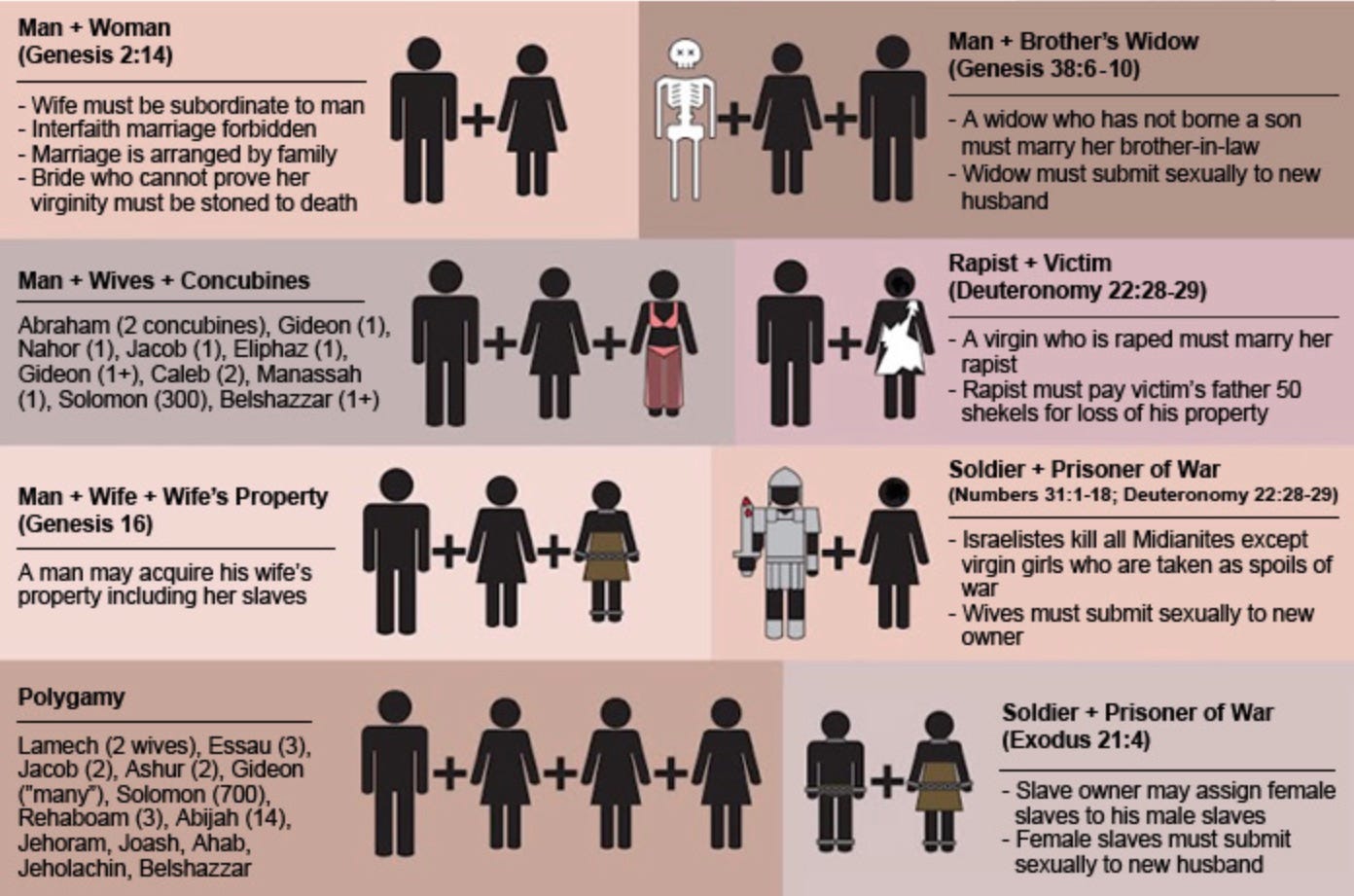
Because the Bible gives us many forms of marriage, including:
A man and a woman
A man, a wife (or wives), and her concubines
A man and multiple wives
A woman and her dead husband’s closest male relative (levirate marriage)
A rapist and his victim
A soldier and his prisoner of war
Two enslaved people forced together by their owner
So if “biblical marriage” is the goal, it’s not nearly as simple—or as holy—as some would like to imagine.
The Genesis Story in Context
The verse about a man clinging to his wife comes from the second creation story (yes, there are two!). This story about Adam and Eve is not history—it’s an origin story that explains why life is the way it is.
It answers questions like:
Why are there men and women? (So they won’t be lonely and can procreate.)
Why do humans ask existential questions when animals don’t? (Because of the Tree of Knowledge of Good and Evil.)
Why is childbirth painful? (A consequence of disobedience.)
Why is life hard? (Because Adam and Eve “messed it up.”)
This story isn’t meant to define sexual orientation, gender identity, or marriage norms. It’s a mythological narrative wrestling with human experience, an etiology.
Jesus and Marriage in Matthew 19
When Jesus quotes Genesis 2:24 in Matthew 19, some claim he is affirming marriage as between a man and a woman. But that’s not what’s happening.
The context is divorce. In the ancient world, a man could dismiss his wife for something as trivial as burning dinner. This left women socially and economically vulnerable, often destitute. Jesus’ teaching here is not about excluding same-sex couples—it’s about standing in solidarity with marginalized women.
Jesus’ Affirmation of the Queer Community
And in the very same chapter, Jesus offers a word of inclusion:
“For there are eunuchs who have been so from birth, and there are eunuchs who have been made eunuchs by others, and there are eunuchs who have made themselves eunuchs for the sake of the kingdom of heaven. Let anyone accept this who can.” (Matthew 19:12)
“Made eunuchs by others” = men castrated to guard women in royal households.
“Eunuchs for the kingdom” = celibates devoted to religious life.
“Eunuchs from birth” = people whose gender identity or sexual orientation didn’t conform to societal norms.
Queer theologians remind us that Jesus explicitly affirmed people who didn’t fit neatly into the categories of his time.
The Takeaway
Genesis 2:24 does not define marriage as between one man and one woman. It is a poetic story about companionship, not a legal template. And when Jesus references it, he’s defending vulnerable women—not excluding LGBTQ+ people.
Even more: Jesus goes out of his way in Matthew 19 to affirm those who live outside binary categories. That affirmation still resounds today.
Article 2 🏳️🌈
False Claim: God Destroys Sodom and Gomorrah because of Homosexuality
Misinterpreted Text:
“Where are the men who came to you tonight? Bring them out to us, so that we may know them.” - Genesis 19:5
A crowd gathers outside Lot’s home — not because of sexuality, but something far more disturbing.
The story of Sodom and Gomorrah is one of the most misunderstood passages in all of Scripture. Much of the confusion comes from reading the text through our own modern lens rather than the ancient world it was written in.
The story isn’t about same-sex love. It’s about a society that had strayed so far from God that it forgot its most sacred obligation: to care for the vulnerable.
Two angels—representatives of God—arrive in the city of Sodom. They are travelers, and therefore vulnerable. Lot, recognizing his duty, invites them into his home to rest, wash, and eat. In the ancient Near East, hospitality wasn’t optional; it was a sacred moral duty. Caring for travelers was a sign of righteousness.
But Sodom had become a place where no one cared about anyone but themselves.
The text says, “Before they lay down, the men of the city, the men of Sodom, both young and old, all the people to the last man, surrounded the house” (Genesis 19:4). Notice: it wasn’t just “the men.” The passage says all the people. The entire city gathered with violent intent to dominate and dehumanize the strangers. Lot, terrified, even offers his daughters in their place—a deeply troubling act, but one that reveals how broken the moral fabric of the city had become.
This story was never meant to be read as history. It’s a moral parable. And the Bible itself tells us exactly what the sin of Sodom was:
“This was the guilt of your sister Sodom: she and her daughters had pride, excess of food, and prosperous ease, but did not aid the poor and needy.”
— Ezekiel 16:49
The sin of Sodom wasn’t love between people of the same gender—it was arrogance, greed, and a lack of compassion. It was a refusal to see the divine image in the other.
That lesson feels painfully relevant today. In a nation where immigrants are detained and deported, where refugees are turned away, and where “outsiders” are demonized for political gain, the story of Sodom should strike uncomfortably close to home. The real moral failure isn’t about sexuality—it’s about our refusal to love our neighbor.
And even if this passage were about sexuality (which it isn’t), there’s still an enormous difference between sexual violence and a consenting, loving relationship between two people of the same gender.
When we stop seeing others as reflections of God, destruction follows. That’s the true lesson of Sodom and Gomorrah.
Just in case it’s more helpful to have this as a video, you can find a quick explanation in the video below.
Article 3 🏳️🌈
False Claim: Leviticus Prohibits Same-Gender Sex
Misinterpreted Texts:
“You shall not lie with a male as with a woman; it is an abomination.” — Leviticus 18:22
“If a man lies with a male as with a woman, both of them have committed an abomination; they shall be put to death; their bloodguilt is upon them.” — Leviticus 20:13
If you’ve ever eaten shellfish, worn clothing made from more than one type of fabric, or gotten a tattoo… congratulations — you’ve broken Levitical law!
It’s fascinating how quickly people dismiss most of the bizarre ancient rules in Leviticus, yet cling tightly to these two verses about same-gender sex. Let’s start with a crucial reminder: Leviticus was written for ancient Israel, not for 21st-century American Christians.
Who Was Leviticus Written For?
Leviticus is a collection of ritual and purity laws given to a specific people in a specific time and place. Its primary purpose was to set Israel apart from the surrounding cultures. Many of its prohibitions — about food, clothing, and bodily functions — served as cultural markers, not timeless moral laws.
By definition, these laws do not apply to Gentiles (non-Jews), which means they were never intended as universal moral codes for Christians. To treat them that way is to misunderstand both their audience and their function.
What Do These Verses Actually Say?
Notice something important: neither verse mentions women. The prohibition seems exclusively directed at male sexual behavior.
And even for men, the meaning isn’t clear. The Hebrew phrase translated as “you shall not lie with a male as with a woman” is, literally, “and with a male not will you lie the lyings of a woman.” Scholars still debate what “the lyings of a woman” even means.
In other parts of the Hebrew Bible, the phrase refers to incestuous relationships. As scholar Amy-Jill Levine notes, “Leviticus 18:22 may be focused on incestuous relations (males in the same family) rather than males from different households.”
If that’s the case, the text isn’t about sexuality in general — it’s about maintaining proper family boundaries.
Other Possible Contexts
When I was in seminary, one common interpretation was economic and patriarchal: in a society where heirs determined property inheritance, every male sexual act needed the potential to produce an heir. Since lesbian sex didn’t involve “seed,” it wasn’t prohibited.
Another theory points to Canaanite temple prostitution. Ritualized “sacred sex” was practiced throughout the ancient Near East, often involving both men and women. Given Leviticus’s emphasis on separating Israel from its neighbors, this passage may have been aimed at rejecting pagan temple practices — not loving, consensual relationships.
What Leviticus Isn’t Talking About
Whatever these verses refer to — incest, ritual sex, or purity taboos — they are not about modern, consensual same-gender relationships.
The text simply doesn’t have the framework for what we mean today by “sexual orientation” or mutual, covenantal love between two adults. Applying these ancient purity codes to modern LGBTQ+ people isn’t biblical fidelity — it’s an act of selective reading.
Leviticus is full of laws no Christian today would dream of following — and for good reason. These passages tell us more about ancient Israel’s identity and social order than about divine condemnation. The tragedy is that they’ve been weaponized against people made, as Genesis says, in the image of God.
📚 Reference
Amy-Jill Levine, “Amy-Jill Levine: How to read the Bible’s ‘clobber passages’ on homosexuality,” https://outreach.faith/2022/09/amy-jill-levine-how-to-read-the-bibles-clobber-passages-on-homosexuality/.
Article 4 🏳️🌈
False Claim: Paul Condemns Sexual Orientation in Romans
Misinterpreted Text:
For this reason God gave them over to dishonorable passions. Their females exchanged natural intercourse for unnatural, and in the same way, also the males, giving up natural intercourse with females, were consumed with their passionate desires for one another. Males committed shameless acts with males and received in their own persons the due penalty for their error.” —Romans 1:26–27
I’ll be the first to admit it—I have a complicated relationship with Paul. In many ways, modern Christianity has become Paulinianity. Too many people are more devoted to Paul’s words than to Jesus’ life. Let’s remember: Paul never actually met Jesus. His so-called “encounter” with the risen Christ was a later embellishment by the author of Luke–Acts.
Once you release the idea that the Bible is the inerrant Word of God, that realization comes with freedom: just because Paul said it doesn’t mean God said it. That distinction matters. It lets us see how Paul’s theology and Jesus’ ministry diverged. Jesus was focused on ushering in the Reign of God on earth—a vision of justice and liberation in the here and now. Paul, on the other hand, was convinced the world was about to end. He believed Jesus would return imminently to fix everything himself.
That difference shifted Christianity from the religion of Jesus to the religion about Jesus.
Paul’s letter to the Romans is particularly interesting because he didn’t start that church, nor had he ever visited it. Unlike his other letters, Romans isn’t written to correct bad behavior—it’s a fundraising letter. He’s trying to secure support for his next missionary trip. The Roman church was mostly Gentile, and Paul is essentially introducing himself, laying out his theology, and making his case for why they should back him.
It’s also worth remembering that Paul’s apocalyptic worldview deeply shaped his sexual ethics. In 1 Corinthians 7, he flatly says that people should avoid marriage and sex altogether if possible—because, after all, why bother starting families when the end is near? That’s not exactly a procreation-friendly theology. In fact, if everyone had followed Paul’s advice, none of us would be here.
With that context, let’s turn to Romans 1.
Paul writes that “God gave them over to dishonorable passions.” But what exactly are those? The phrase is ambiguous. And it’s striking that Paul includes women here—Leviticus, you might recall, said nothing about women at all.
The key, though, is what comes right before these verses: “They exchanged the truth about God for a lie and worshiped and served the creature rather than the Creator” (v. 25). In other words, Paul isn’t railing against sexual orientation. He’s condemning people who, in his view, have misplaced their worship—who have given themselves over to lust rather than to God. For Paul, that’s the real “unnatural” act: serving the creature (human desire) over the Creator.
When Paul says “unnatural,” he’s not talking about what is biologically natural or unnatural. He’s talking about what’s against custom—what doesn’t serve the cultural expectation of procreation. Sex, in his worldview, existed for one purpose: producing heirs. Sex for pleasure or intimacy didn’t fit his theology.
Paul isn’t describing loving, consensual, same-gender relationships. He’s describing what he sees as excessive, self-serving lust—and warning against it because he thinks time is running out.
That’s the irony of it all: Paul’s argument against “unnatural relations” collapses under the weight of its own context. He thought the world would end within his lifetime. It didn’t. And his sexual ethics were shaped by that urgency, not by any timeless truth about human love.
When we read Romans 1 today, our goal shouldn’t be to twist the text into saying what we want—it’s to contextualize it. To understand what Paul was actually saying to his audience in his time.
And once we do that, it becomes clear: Paul’s problem wasn’t with LGBTQ+ people. His problem was with unrestrained lust and misplaced worship.
Our problem today is that the church has taken his words—born from fear and expectation of the world’s end—and turned them into weapons against people who simply want to love and be loved.
Maybe it’s time to stop confusing Paul’s panic for God’s truth.
📚 Read More
The Reformation Project, https://reformationproject.org/case/romans/.
Article 5 🏳️🌈
False Claim: The word “homosexual” is in the Bible
Misinterpreted Text:
“Do you not know that the unrighteous will not inherit the kingdom of God? Do not be deceived; neither the immoral, nor idolaters, nor adulterers, nor sexual perverts [originally homosexuals], nor thieves, nor the greedy, nor drunkards, nor revilers, nor robbers will inherit the kingdom of God.” —1 Corinthians 6:9-10, RSV
When I was in seminary at Yale Divinity School, there was a classroom called The RSV Room—named for the Revised Standard Version of the Bible, which was compiled there. The school was proud of that translation. It was the gold standard for mainline Protestants for decades. The New Revised Standard Version Updated Edition that I typically use descends from it.
But buried in that celebrated translation is a catastrophic mistake — one that never existed in scripture until 1946. And that single mistranslation helped build modern Christian homophobia.
And yes, we can prove it.
The Translation Problem No One Told You About
Let’s start with the basics.
Jesus spoke Aramaic. The first Gospel, Mark, was written roughly 40 years after Jesus’ death—in Koine Greek. Those Greek writings were later translated into Latin (the Vulgate), and much later, the earliest English versions translated the Latin into English.
So that’s:
Aramaic → Greek → Latin → English.
You don’t need a seminary degree to see how much gets lost—and added—across multiple translations.
When the King James Version came along, it didn’t rely on the Latin, but it had other problems. It’s poetic, yes. But it also contains a unicorn. (Seriously—Psalm 22:21; check it.) When scholars in the 20th century realized that people no longer spoke in Shakespearean English—and also, maybe, that unicorns might not be biblically reliable—they assembled a more accurate translation.
Thus came the Revised Standard Version (RSV) of the New Testament in 1946. It became the academic and mainline Protestant standard. But it also introduced something that had never existed in any English Bible before:
The word “homosexual.”
1946: The Year “Homosexual” Appears in the Bible
In 1 Corinthians 6:9–10, the RSV inserted the word homosexuals into Paul’s list of those who “will not inherit the kingdom of God.”
That word is not in the Greek.
It had never appeared in any translation prior to 1946.
And the translators knew it was questionable—they added a footnote trying to justify the choice by combining two Greek terms:
malakoi
arsenokoitai
Except… that’s not translation.
It’s interpretation.
And it’s wrong.
What the Greek Actually Means
malakoi: literally “soft.” In the ancient world, it referred to men who were passive, submissive, or lacked moral courage. Think “morally weak,” not “gay.”
arsenokoitai: a made-up word, appearing nowhere before Paul. It combines arsen (man) and koitai (bed). Scholars point out that Paul is likely condemning a known Roman system: pederasty.
Pederasty was a cultural structure where powerful older men “initiated” young boys—often below our age of consent—into society through sexual domination. These were not relationships. They were exploitation and abuse. When the word is used in subsequent lists, it’s always referring to exploitation.
In other words:
Paul isn’t condemning LGBTQ+ people.
He’s condemning sexual violence and power abuse.
Which, by the way, is exactly what Jesus did too.
Why This Matters
I am not interested in defending the Bible as “inerrant.” Anyone who has ever heard me preach knows that. Every Sunday following the scripture reading, our church says:
“Here ends the reading of words that give us insight on God.
May God grant us wisdom and courage for interpretation.”
We say that because scripture is human.
Scripture contains beauty, justice, liberation—and also fear, xenophobia, patriarchy, and pain. It was written by real people with real limitations.
Likewise, I’m not here to defend Paul. Some of his work is breathtakingly beautiful:
“Love is patient, love is kind…”
And sometimes Paul was deeply wrong.
He thought the world would end in his lifetime.
Spoiler: it didn’t.
But what I am interested in is accuracy.
The RSV mistranslated malakoi and arsenokoitai—and that mistranslation helped institutionalize homophobia in the church for the next 75 years.
We Can Prove It
The documentary 1946: The Mistranslation That Shifted Culture follows researchers who dug through the correspondence of the RSV translation committee—right at my alma mater, Yale Divinity School. They found letters between a seminarian and the chair of the translation committee that led to a change in the translation.
In other words:
People noticed.
Experts objected.
And the committee admitted it was a mistake.
But the damage was done.
Evangelicals adopted the word.
Mainliners absorbed it.
And a Bible printed in 1946 helped fuel the political weaponization of LGBTQ+ people in American Christianity.
A translation error became a culture war.
So Let’s Say It Clearly
Paul was not condemning loving, mutual relationships.
He was condemning abuse, exploitation, and coercion—things Jesus condemned too.
A mistranslation turned LGBTQ+ people into theological targets.
Correcting it is not “rewriting the Bible.”
It’s undoing the damage someone else wrote into it.
And that is holy work.
📚 Reference
Check out 1946: The Mistranslation That Shifted Culture.
Article 6 🏳️🌈
False Claim: Paul Condemns Homosexuality in 1 Timothy
Misinterpreted Text:
“Now we know that the law is good, if one uses it legitimately; this means understanding that the law is laid down not for the righteous but for the lawless and disobedient, for the godless and sinful, for the unholy and profane, for those who kill their father or mother, for murderers, the sexually immoral, men who engage in illicit sex, slave traders, liars, perjurers, and whatever else is contrary to the sound teaching that conforms to the glorious gospel of the blessed God, with which I was entrusted.” — 1 Timothy 1:8–10, NRSV
Let’s Start with the Obvious: Jesus Never Said It
If you’ve been following this series on the so-called “clobber passages” used against the LGBTQ+ community, you may have noticed something:
Not one of these verses comes from Jesus.
That’s because Jesus never said a single word condemning queer people. Not one.
Every “anti-gay” New Testament verse used by modern-day fundamentalists comes from texts written long after Jesus’ ministry — and often by people pretending to write in his apostles’ names.
Paul Didn’t Write 1 Timothy
Here’s the first truth to get clear: Paul didn’t write this letter.
Yes, his name is on it, but in the ancient world, it was common to write under the name of a revered teacher if you believed you were carrying on their legacy. Scholars across the theological spectrum agree that the Pastoral Epistles (1 & 2 Timothy and Titus) were written after Paul’s lifetime — by followers trying to preserve what they thought Paul would say.
Except they didn’t quite get him right.
The real Paul — for all his flaws — was actually progressive for his time. He partnered with women like Phoebe, Junia, Priscilla, and Lydia in leadership. He wrote about equality in Christ that transcended gender, class, and ethnicity. But by the time of the Pastoral Letters, the tone had changed. Later writers started walking back that inclusion, trying to make the growing Jesus movement fit more comfortably within the patriarchal Roman world.
The Phrase in Question: “Men Who Engage in Illicit Sex”
So what about that line — “men who engage in illicit sex”?
First, let’s notice what’s missing: this text says nothing about women.
Just like Leviticus, if this were truly about condemning same-gender relationships, it’s strangely one-sided. Lesbians are nowhere to be found in the supposed “biblical ban.”
Second, even the translators admit they’re not sure what this phrase means. In the NRSV, there’s a footnote that reads, “Meaning of the Greek uncertain.” That’s because the Greek word arsenokoitai — the same one misused in 1 Corinthians 6 — has a murky, context-dependent meaning. It’s not about loving, mutual same-gender relationships; it’s about exploitation.
The Real Meaning: Sexual Abuse and Exploitation
In the Greco-Roman world, arsenokoitai referred to men who sexually exploited others — especially boys — through a system called pederasty.
This was not consensual. It was institutionalized abuse.
Older, powerful men “initiated” young boys (often enslaved or underage) into society through acts of sexual domination. That’s what this word points to — power, coercion, and exploitation, not mutual love or orientation.
And that interpretation is reinforced by the company this word keeps. It’s sandwiched between two other terms:
Pornois — meaning the “sexually immoral,” often referring to sexual slavery or trafficking.
Andrapodistais — meaning “slave traders” or kidnappers.
Put together, these words describe a pattern: people who profit from or participate in the sexual exploitation of others.
That’s not the queer community. That’s the Jeffrey Epsteins of the ancient world.
The Real Sin: Exploitation, Not Identity
This passage isn’t about condemning same-gender love.
It’s about condemning abuse, coercion, and human trafficking — acts that strip others of dignity and agency for personal gain.
When modern-day preachers twist this text to attack LGBTQ+ people, they are doing the exact opposite of what the author intended.
They are weaponizing scripture meant to protect the vulnerable against the vulnerable themselves.
That’s spiritual malpractice.
What This Means for Us
If we read this passage honestly, it exposes not queer people but the hypocrisy of those who claim to defend “biblical values” while ignoring the exploitation in their own ranks — from cover-ups of abuse to systems that profit from inequality.
When Paul (or pseudo-Paul) talks about “sound teaching,” it’s not about enforcing purity culture. It’s about aligning our lives with the gospel’s core: liberation, justice, and love.
So no, this text doesn’t condemn gay men or queer people. It condemns those who use power to harm others.
And maybe it’s time the church finally took that part seriously.
📚 Reference
Amy-Jill Levine, “How to read the Bible’s ‘clobber passages on homosexuality,” https://outreach.faith/2022/09/amy-jill-levine-how-to-read-the-bibles-clobber-passages-on-homosexuality/.
Article 7 🏳️🌈
False Claim: “Sodomites” Are Going to Hell!
Misinterpreted Text:
“And the angels who did not keep their own position but deserted their proper dwelling, he has kept in eternal chains in deepest darkness for the judgment of the great day. Likewise, Sodom and Gomorrah and the surrounding cities, which, in the same manner as they, indulged in sexual immorality and pursued unnatural lust, serve as an example by undergoing a punishment of eternal fire.” — Jude 6–7 (NRSV)
Let’s Start With Hadestown
I love the musical Hadestown. Maybe it’s because I’m a trombone player and the show opens with an absolutely awesome trombone lick. But beyond the music, Hadestown does something brilliant: it retells an ancient myth in a modern setting, reminding us what those old stories were trying to teach—about power, injustice, and the interplay between divine beings and human lives.
And ironically, that is exactly the sort of worldview you need to understand what Jude is doing in this so-called “clobber passage.”
Because long before Christian fundamentalists weaponized this text against LGBTQ+ people, the ancient world already had plenty of stories about gods, goddesses, and divine beings wandering down to earth and getting a little too friendly with mortals.
And Jude is dipping right into that cultural stream.
Meet Jude: The Odd Little Book Before Revelation
Jude is the next-to-last book of the Bible and just 25 verses long. It’s not the shortest book in scripture, but it’s in the running. It’s also… odd.
It’s a letter that probably wasn’t written by the person whose name is attached to it.
It references angelic rebellions, mysterious ancient texts, and cosmic judgment.
It reflects a lively First-Century Jewish debate about angels: What are they? What can they do? Where do they belong?
In other words, Jude is not thinking about modern questions of sexual orientation. He’s thinking about divine beings crossing cosmic boundaries.
A Quick Refresher: What Happened in Sodom?
In Genesis, the “strangers” who enter Sodom are not just strangers—they’re angels. Lot offers them hospitality. The townspeople want to commit violence against them. The story is meant to show how thoroughly the city has abandoned any semblance of decency.
But this story was never meant as a historical account. It’s a moral parable.
And the Bible itself tells us, in plain language, what the sin of Sodom actually was:
“This was the guilt of your sister Sodom: she and her daughters had pride, excess of food, and prosperous ease, but did not aid the poor and needy.”
— Ezekiel 16:49
The sin of Sodom wasn’t love between two people of the same gender.
The sin was arrogance. Greed. Violence. A refusal to see the divine image in the vulnerable.
It was a justice issue, not a sexuality issue.
So What Is Jude Talking About? (Spoiler: Not Queer People)
Jude takes the old Sodom story and does something unexpected:
He flips the blame.
According to Jude, the angels themselves “deserted their proper dwelling.” In First-Century Jewish and Greco-Roman culture, this wasn’t a strange idea at all. Divine beings routinely crossed boundaries to meddle in human affairs—sometimes violently, sometimes sexually.
As Amy-Jill Levine notes, Jude is engaging a very specific debate of his time:
What happens when divine beings cross the line and consort with humans?
If you think back to Greco-Roman mythology, the examples practically write themselves:
Zeus and Leda – Zeus transforms into a swan to seduce (or, depending on the story, assault) Leda, producing Helen of Troy and Pollux.
Zeus and Alcmene – Zeus takes the form of Alcmene’s husband Amphitryon to sleep with her, resulting in the birth of Heracles.
Poseidon and Medusa – Poseidon sleeps with Medusa in Athena’s temple, which leads to divine punishment of Medusa rather than Poseidon.
Apollo and Coronis – Apollo impregnates Coronis, a mortal woman, producing Asclepius, the god of medicine.
Jude is doing exactly what Hadestown does: retelling an old story through the lens of his own world. In his retelling, the “unnatural lust” isn’t about humans loving other humans. It’s about angels stepping out of their realm and getting involved with mortals.
The Bottom Line
Jude’s reference to Sodom has nothing to do with LGBTQ+ people or consensual human relationships.
It’s about divine beings crossing cosmic boundaries—a theological issue, not a sexual one.
The real biblical condemnation of Sodom is the one from Ezekiel:
Pride. Hoarded wealth. Indifference to the poor.
A refusal to see dignity in the vulnerable.
If anyone today wants to talk about “the sin of Sodom,” that’s where the conversation needs to begin.
📚 Reference
Amy-Jill Levine, “How to read the Bible’s ‘clobber passages on homosexuality,” https://outreach.faith/2022/09/amy-jill-levine-how-to-read-the-bibles-clobber-passages-on-homosexuality/.
Article 8 🏳️🌈
LGBTQ+ Inclusion: David & Jonathan
Queer Theology’s Most Famous Love Story
Scripture
“When David had finished speaking to Saul, the soul of Jonathan was bound to the soul of David, and Jonathan loved him as his own soul.”
— 1 Samuel 18:1
“I am distressed for you, my brother Jonathan; greatly beloved were you to me; your love to me was wonderful, surpassing the love of women.”
— 2 Samuel 1:26
More Than “Just Friends”? Absolutely.
Whenever someone insists, “There are no same-gender relationships in the Bible,” queer theologians raise an eyebrow and gently point them toward David and Jonathan.
Were they friends?
Possibly.
Were they lovers?
Quite likely.
These aren’t subtle verses. The Hebrew writers weren’t shy. We get at least six deeply intimate passages describing a love that binds their souls together and a relationship David himself claims surpassed “the love of women.” That is not standard bro-talk. That’s erotic poetry.
And remember: the category “homosexuality” didn’t exist until the nineteenth century. But LGBTQ+ people did. Ancient cultures simply understood sexuality and gender differently than we do today—yet same-gender relationships were present, visible, and acknowledged.
David and Jonathan’s relationship reads exactly like what we would describe today as a loving, consensual same-gender romantic relationship.
“But David Had Wives…” — Yes, and That Proves Very Little
Yes, David married several women. Yes, the text says he “took” Bathsheba—a morally devastating story in its own right.
None of that disqualifies the possibility that David also loved Jonathan romantically.
He could have been bisexual, or he could have entered those marriages because that’s simply what ancient Near Eastern men did to maintain status, lineage, and political alliances. Being publicly devoted to another man would not have been socially acceptable—but it certainly happened behind the scenes.
And it’s worth noting:
David’s relationship with Jonathan appears far healthier than any of his relationships with women. Mutuality. Covenant. Tenderness. Consent. Emotional depth. All things in short supply elsewhere in David’s story.
The Ancient World Was Far Queerer Than Evangelicals Want to Admit
We often forget: same-gender relationships were not fringe or forbidden in the ancient Near East. They were widespread and often seen as simply part of life.
Ancient Near Eastern texts contain homoerotic poetry strikingly similar in tone to David’s lament for Jonathan.
Greco-Roman culture included openly same-gender relationships, especially among men.
Hebrew scriptures never condemn a loving same-gender relationship—only specific acts tied to violence, dominance, purity codes, or idolatry.
So when queer theologians read David and Jonathan, they’re not reading “modern ideas back into the text.” They’re reading the text for what it actually says—and taking seriously the world it emerged from.
What This Story Actually Offers Us
Let’s be honest: the Bible is generally not a great handbook for modern relationships. Most biblical marriages would be illegal today, and for good reason.
But Scripture is a powerful guide for agape—love that seeks the good of the other.
David and Jonathan show us a relationship grounded in:
mutual affection
covenantal loyalty
emotional honesty
dignity and respect
desire for the other to flourish
Queer or straight, romantic or platonic, every relationship worth having should be measured by those values.
This isn’t a passage about sexual “sin.”
It’s a passage about what holy love looks like.
And holy love has no gender restrictions.
A Closing Prayer
May we pursue relationships—of every kind—that are marked by delight, mutuality, and flourishing.
May we recognize the sacredness of LGBTQ+ love wherever it appears.
Amen.
📚 Reference
I write more about this in Week 22 of my book Awakened: A 52 Week Progressive Christian Devotional (Chalice, 2024).
Article 9 🏳️🌈
Giving Up Bad Theology: Love the Sinner, Hate the Sin
When conditional acceptance masquerades as Christian love
You know what’s not anywhere in the Bible?
“Love the sinner, hate the sin.”
Go ahead. Look for it.
You’ll find Genesis. You’ll find Exodus. You’ll find the prophets. You’ll find the Gospels. You’ll find Paul. You’ll find Revelation.
What you won’t find is Jesus saying, “Love the sinner, hate the sin.”
Since it’s Pride Month, I thought we’d start by examining one of the most common phrases used against LGBTQ+ people. It’s quoted so often that many Christians assume it comes straight from Jesus himself.
It doesn’t.
The phrase is usually traced back to Augustine, one of the most influential theologians in Christian history—and, in my view, one of the biggest contributors to some of Christianity’s most harmful theological ideas. Centuries later, the phrase was popularized by Gandhi, who acknowledged just how difficult it is to separate a person from their actions.
As a general moral principle, the idea isn’t entirely unreasonable. We can oppose harmful actions while still affirming the dignity of the people who commit them. Most of us do this every day. We can condemn dishonesty without hating liars. We can oppose violence without denying someone’s humanity.
But that’s not how this phrase is typically used.
Especially when it comes to LGBTQ+ people.
The Problem Isn’t the Saying. It’s How It’s Used.
In practice, “love the sinner, hate the sin” rarely functions as an invitation to love.
It functions as a disclaimer.
It’s what people say immediately before rejecting someone.
“I love you, but...”
“I love you, but I don’t support your lifestyle.”
“I love you, but I don’t think you should get married.”
“I love you, but I don’t think your relationship is real.”
“I love you, but I don’t think you should be allowed to serve in ministry.”
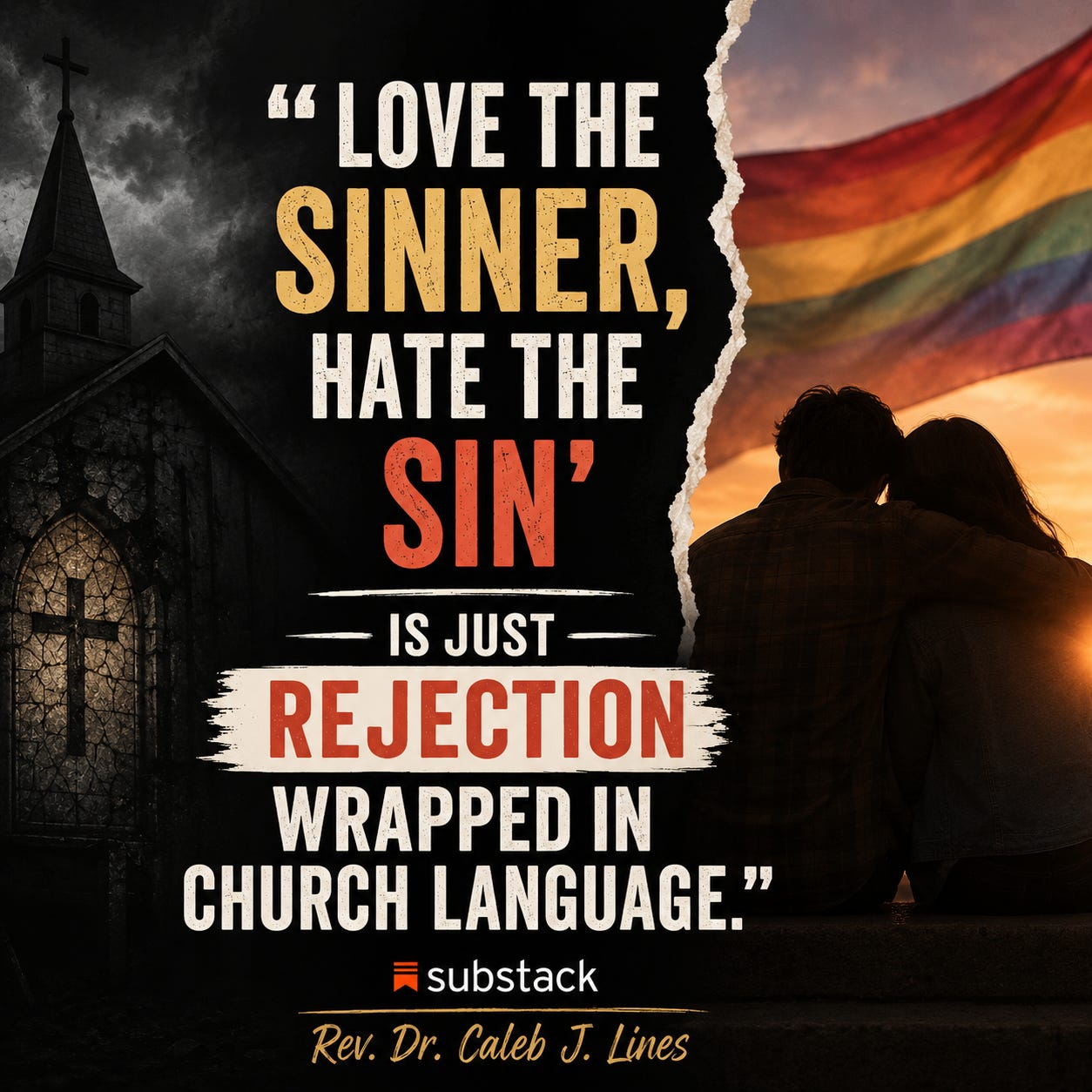
That’s not love.
That’s rejection wrapped in church language.
It’s a way of making someone feel unwelcome while convincing yourself you’ve done nothing wrong.
And here’s the problem: sexuality isn’t some detachable accessory that can simply be separated from a person’s identity. Telling someone you love them while condemning an integral part of who they are doesn’t feel loving. It feels like being tolerated.
Most LGBTQ+ people have heard this phrase before. Many have heard it from parents. From pastors. From churches. From people who sincerely believed they were being compassionate.
Yet the result is often shame, isolation, anxiety, depression, and spiritual harm.
If your version of love consistently leaves people feeling rejected, it may be worth asking whether it’s actually love.
Jesus Never Added an Asterisk to Love
When we turn to Jesus, something remarkable happens.
He never seems interested in narrowing the circle of love.
He’s always expanding it.
In Luke’s Gospel, Jesus identifies the greatest commandments: love God and love your neighbor as yourself.
When someone asks him, “Who is my neighbor?” Jesus responds with the parable of the Good Samaritan.
That answer matters.
Because Samaritans weren’t the obvious choice. They were outsiders. Religious rivals. People viewed with suspicion and contempt.
Jesus intentionally chose someone from outside the accepted group and made him the hero of the story.
Then Jesus goes even further.
“You have heard that it was said, ‘Love your neighbor and hate your enemy.’ But I say to you, love your enemies and pray for those who persecute you.” (Matthew 5:43-44)
Notice the direction of movement.
Jesus keeps expanding the circle.
Neighbors become outsiders.
Outsiders become beloved.
Even enemies become recipients of love.
Jesus never says, “Love your neighbor, but hate the part of them you don’t understand.”
Jesus never says, “Love your enemy, but only after you’ve identified the parts of them that are unacceptable.”
Jesus keeps pushing people toward greater compassion, greater empathy, and greater connection.
Love gets bigger.
Not smaller.
Created in the Image of God
Scripture tells us that human beings are created in the image and likeness of God.
That truth doesn’t come with exceptions.
It doesn’t exclude people because of race, gender, nationality, disability, or sexual orientation.
And it doesn’t exclude LGBTQ+ people.
If queer people are created in the image of God—and they are—then their lives, relationships, experiences, and identities reveal something about the beauty and diversity of God’s creation.
Too often, churches have asked LGBTQ+ people to hide who they are in order to belong.
But when people are forced to suppress their authentic selves to gain acceptance, something sacred is lost.
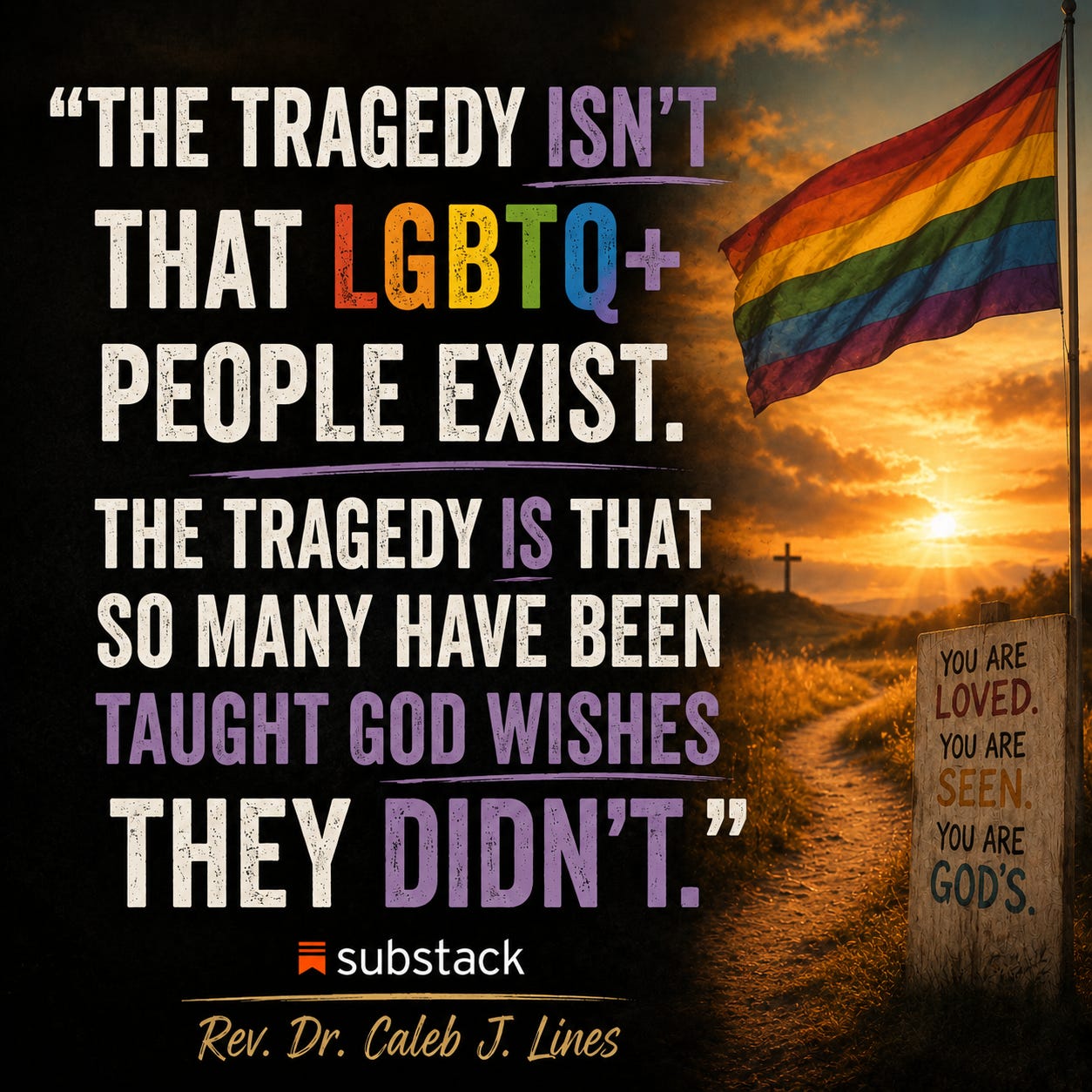
The tragedy isn’t that LGBTQ+ people exist.
The tragedy is that so many have been taught to believe that God wishes they didn’t.
Love Means Seeing People Fully
At its core, “love the sinner, hate the sin” fails because it misunderstands love itself.
Love is not merely tolerating someone.
Love is not refusing to see them.
Love is not demanding that they become someone else before they are worthy of belonging.
Love sees people fully.
Love recognizes their humanity.
Love honors their dignity.
Love celebrates the image of God within them.
If your spirituality requires you to hate a part of another person, it may be worth asking whether you’re truly following Jesus—or simply protecting your own comfort, certainty, and control.
Because Jesus never told us to tolerate people.
Jesus told us to love them.
This Pride Month, let your light shine.
And the next time someone says, “Love the sinner, hate the sin,” remind them:
That’s Augustine.
Not Jesus.
Article 10 🏳️🌈
MAGA vs. Jesus: LGBTQ+
The Gospel Was Never Meant to Be Used as a Weapon
MAGA says: “Being gay or trans is sinful.”
Jesus says: “There are those who have been eunuchs since birth.” — Matthew 19:12
As Pride Month approaches, many politicians and pastors will once again try to convince people that Christianity and LGBTQ+ affirmation are incompatible.
But here’s the problem:
Jesus never said that.
Not once.
In fact, I’ve challenged people repeatedly on social media to name a single teaching of Jesus that condemns LGBTQ+ people, and they can’t do it. Because it doesn’t exist.
What does exist are countless teachings about love, compassion, mercy, inclusion, humility, justice, and refusing to weaponize religion against vulnerable people.
And honestly? I would go so far as to say this:
Any hateful theology is anti-Christian.
Because Jesus gave us the ultimate test for all theology: love.
If your interpretation of scripture produces cruelty instead of compassion, exclusion instead of embrace, shame instead of healing, then something has gone terribly wrong.
Unfortunately, Christians have often been among the loudest voices harming LGBTQ+ people in America. We’ve used the Bible as a tool of oppression rather than liberation. We’ve driven people away from churches, families, and even from life itself.
That is not the fruit of the Gospel.
Because the Gospel is centered on love.
What Jesus Actually Said
One of the most overlooked passages in this conversation appears in Matthew 19, buried in a teaching about divorce. Jesus mentions three kinds of eunuchs:
Those who choose to live as eunuchs for the sake of the Reign of God
Those who have been made eunuchs by others
And those who have been “eunuchs since birth”
The first category refers to people who abstain from romantic relationships for spiritual reasons—priests, monks, religious ascetics, and others devoted entirely to God.
The second refers to those who were physically castrated, often so they could serve in royal courts or guard harems without threatening patriarchal bloodlines.
But the third category is where things become fascinating.
“There are those who have been eunuchs since birth.”
Queer theologians have long pointed out that this category likely included people who did not fit neatly into ancient expectations surrounding gender, sexuality, or procreation. In the ancient world, if someone’s relationships or desires fell outside the norms of heterosexual reproduction, they were often placed into the broad category of “eunuch.”
In other words, Jesus explicitly acknowledges people who were born different.
And instead of condemning them, he includes them.
That matters.
Especially because Jesus lived in a world obsessed with purity boundaries, gender expectations, and exclusion.
Yet over and over again, Jesus crossed those boundaries.
The First “Outsider” Welcomed into the Church
Then there’s Acts 8.
An Ethiopian eunuch approaches Philip and asks to be baptized.
Philip doesn’t interrogate him.
He doesn’t demand repentance for his identity.
He doesn’t create a doctrinal purity test.
He baptizes him.
Immediately.
And many scholars point out something profound here: this eunuch may very well have been the first Gentile convert welcomed into the Christian movement.
Think about that.
The first outsider welcomed fully into the body of Christ may have been someone whose gender or sexuality placed them outside the social norms of the ancient world.
That’s not accidental.
Luke could have chosen anyone for this story.
Instead, scripture centers someone who religious gatekeepers would have considered “other.”
Because that’s what the Gospel keeps doing.
The Real Test of Christian Faith
Sometimes people wish the Bible addressed modern questions with modern language. But scripture emerged from ancient cultures with ancient frameworks and limited understandings of sexuality and gender identity.
Jesus wasn’t talking about sexual orientation the way we understand it today because nobody in the first century understood it that way.
But when we read scripture through the lens Jesus actually gave us—love of God and love of neighbor—the trajectory becomes clear.
Again and again, Jesus moves toward the marginalized.
Again and again, religious leaders try to draw lines around who belongs.
Again and again, Jesus erases those lines.
That’s why anti-LGBTQ+ Christianity fails the test of Jesus.
Because theology that produces despair, self-hatred, rejection, violence, homelessness, bullying, or suicide among vulnerable people is not bearing good fruit.
And Jesus was very clear about fruit.
“You will know them by their fruits.” — Matthew 7:16
Everybody’s In, Nobody’s Out
The Gospel is not about fear.
It’s not about exclusion.
It’s not about policing bodies or identities.
The Gospel is the announcement that God’s love is bigger than the boundaries humans create.
And that means LGBTQ+ people are not mistakes to be fixed.
They are beloved children of God.
Fully worthy of love.
Fully worthy of dignity.
Fully worthy of belonging.
The message of Jesus is clear:
Everybody’s in. Nobody’s out.
May we proclaim that truth loudly, especially when so many voices are misrepresenting the Gospel.
May it be so. Amen.
Thank you for this. It feels like a hug. 🫂
❤️🧡💛💚💙💜
Love the article, definitely helps thank you. I am confused by this. "His so-called “encounter” with the risen Christ was a later embellishment by the author of Luke–Acts."
Are you saying Paul's encounter didn't happen? If it didn't why did he change so suddenly from hating Christians to loving them?
Thanks